Current Topics
21 Questions to Ask College Admissions Reps
While high school buildings are shuttered, college campuses are closed to visitors, and many of us are home sheltering in place, the online world is buzzing. Virtual college fairs - webinars - FaceBook Live events -- there are copious opportunities for curious juniors -- and even seniors -- to continue a fruitful college search.
Connecting with college representatives and current students in person is preferable to making socially-distant connections, but face it: A junior has to do what a junior has to do. Fortunately, there are loads of colleges out there kicking off ways to connect with prospects. There is endless information available to curious parents and students involved in the college search process!
Learning starts with asking good questions, but what sorts of questions are useful for getting more out of online college presentations? And after all, aren't college websites full of information?
Here are 21 questions that students might find useful for kicking off a conversation -- or maybe these raise still additional questions that you had not yet thought of. Some of these might be best posed to the Admission Office, while others, such as "What do students say they would like to change at the school?" or "What is the straight story about substance use at this school?" would be best put in front of a peer student.
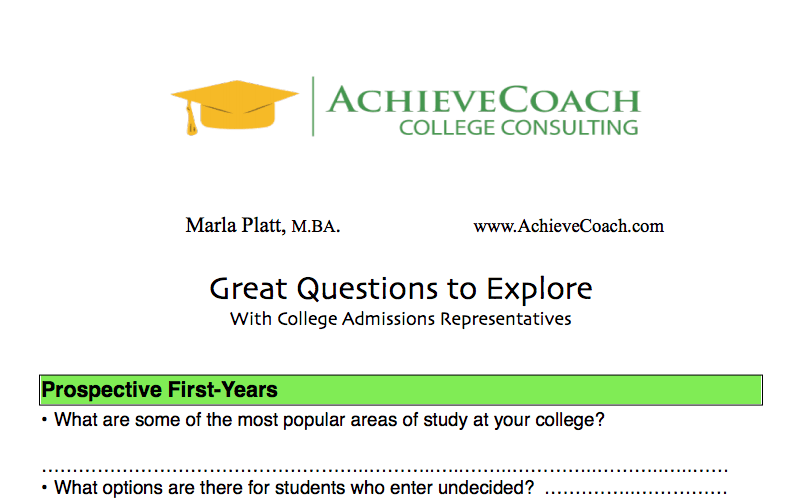
Here is an extensive list to check out -- along with a live link to a handy worksheet that features more Great Questions to Explore With College Admissions Representatives
Turn to these 21 questions during your college search process:
- What is the process for financial aid application?
- What do students say they would like to change at the school?
- Am I guaranteed freshman housing? After freshman year, where do students live?
- Describe the opportunities for students to sample different academic areas.
- How common is minoring or double majoring?
- What leadership opportunities are there for freshmen or sophomores?
- How students in (my major) begin to make contacts via the school for jobs or internships?
- What does the school do to support healthy lifestyles? ex. healthy food; healthy activity; alternatives to drugs or alcohol
- What are the study abroad programs like at your school? Requirements to be eligible?
- Describe core or distribution requirements. How flexible are these?
- How do you handle advance credit? ex. AP; IB; outside college credits.
- Describe student safety concerns on campus. How about safety in the local community?
- What is the path for research work with professors?
- How does faculty advising work at your school?
- Tell me about the most popular areas of study at your school.
- How big is the XYZ Department at your school? Is it growing?
- Describe the most popular activities for students during the weekend.
- What opportunities are there for merit scholarship?
- How do students get to and from campus? How close would I be to an airport; rail or bus stations?
- What is the connection like between students on campus and the local community?
- Anything else that is on your mind about the student learning and living experience...?
Marla Platt, M.B.A. is an independent college consultant based in Sudbury, MA through AchieveCoach College Consulting, providing expert and personalized college counseling to students and families throughout the college planning, search and admissions process. Marla is a professional member of the Independent Educational Consultants Association and can be reached via www.achievecoach.com
Serving high school students in:
Sudbury, Wayland, Acton, Groton, Hopkinton, Newton, Wellesley, Weston, Natick, Needham, Brookline, Bolton, Concord, Carlisle, Lexington, Framingham, Dover, Sherborn, Grafton, Hopkinton, Arlington, Cambridge and all of Metrowest Boston and New England.
Recent posts