Current Topics
Do I Need to Write the Optional SAT Essay?
Bill Sholar • May 21, 2020

THIS POSTING HAS BEEN REVISED TO REFLECT FREQUENTLY-CHANGING SAT ESSAY POLICIES.
The optional SAT essay, requiring an additional 50 minutes of test takers' time, focus and energy, is swiftly becoming an artifact.
Like the vestigial human appendix, at one point in time this component of the standardized testing landscape had its purpose. Today, more often than not, the essay score is simply disregarded, serving no true function in evaluating applicants, so says the testing policy
at the vast majority of colleges and universities. Still, every year we grapple with the wisdom of signing up for the optional essay.
Testing Requirements Run the Gamut
How should students approach the decision of whether or not to sit for the optional essay? General wisdom has long suggested that the smart and safe move would be to write the essay
because without it colleges that do require this component will regard the main two-part SAT score, consisting of Evidence-Based Reading and Writing
plus Math, to be incomplete.
So what are the policies that colleges hold around the essay? Schools such as Bates, NYU, Quinnipiac, Connecticut College, UConn neither require nor recommend the optional essay
and will not consider its score at the time of application review. No longer does the College of Charleston or Occidental even recommend the essay, a relatively recent change. As of last year, Duke stopped requiring it. None of the Ivies require the essay. So who does?
Look West
Primarily, the University of California system institutions (ex. UCLA; UC San Diego; etc.) and Stanford still ask for the essay. A student applying to these schools will need
to submit their essay score in order to complete their application.
Future Tense
Another possible rationale behind writing the essay is as a back-up in the event a student later decides to transfer
colleges, and the destination college is one that requires the SAT essay score for admission -- including transfer admission. Without a complete score, the SAT two-part score may be regarded as insufficient.
International applicants
whose language of instruction is not English may consider writing the essay to lend another perspective to their TOEFL or IELTS score.
In the present timeframe, if a student feels that they will likely have remaining mental focus
to satisfactorily write the essay after completing the main SAT sections, then they might just pay the extra $15 fee and register for the essay. And after once completing the essay and if satisfied with the two-part score, the student may not need to write the essay again in future testing scenarios. In other words, when it comes to the essay more often than not it's "one and done."
If a student wants to learn more about the essay section (highly-recommended prior to test day), click here
to learn more about the approach
to writing the essay and the skills assessed.
Marla Platt, M.B.A. is an independent college consultant based in Sudbury, MA through AchieveCoach College Consulting, providing expert and personalized college counseling to students and families throughout the college planning, search and admissions process. Marla is a professional member of the Independent Educational Consultants Association and can be reached via www.achievecoach.com
Serving high school students in:
Sudbury, Wayland, Acton, Groton, Hopkinton, Newton, Wellesley, Weston, Natick, Needham, Brookline, Bolton, Concord, Carlisle, Lexington, Framingham, Dover, Sherborn, Grafton, Hopkinton, Arlington, Cambridge and all of Metrowest Boston and New England.
Recent posts

What makes a high school passion project meaningful to selective college admissions, and how to help your student build one that lasts.

When choosing a college, campus mental health resources matter as much as academics. Learn what to look for, what to ask, and which schools earned the 2026 Princeton Review Mental Health Services Honor Roll.

The ACT Science section is now optional at most colleges. Find out exactly who requires it, who recommends it, and how to decide if it's right for your college list.

Colleges with rolling admissions review your application as it arrives — no waiting for a deadline. Discover the top schools and how to apply strategically.

What do colleges really look for in applications? A college consultant explains what matters most—from grades to activities to personal fit.
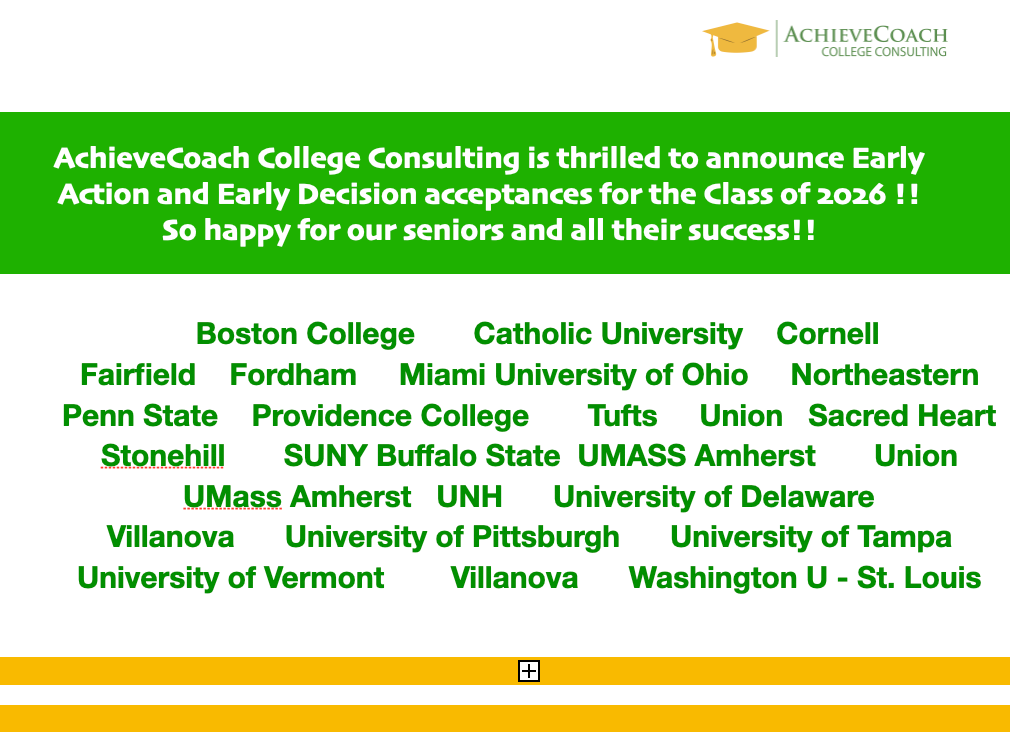
ADMISSIONS ACHIEVED!! Here are some of the colleges our students have been admitted to